EN
EN

What to Check Before Buying a Rechargeable Cat Water Fountain
A rechargeable cat water fountain can make it easier to place fresh water away from outlets, but cordless convenience is only useful when the fountain is safe, easy to maintain, and suitable for your cat’s routine. As a buyer, look beyond a battery headline. Check how the fountain runs between charges, how often it needs attention, and whether its parts make daily water care realistic in your home.
Fountains can be appealing because moving water interests some cats, but they should not be treated as a universal hydration solution. Individual preferences vary. Keep a familiar water option available while your cat adjusts, and contact a veterinarian promptly if you are concerned about dehydration or a sudden change in drinking behavior.
Start with the battery claim, then ask how it was measured
The first question for a rechargeable cat water fountain is not simply “How many mAh?” A battery capacity number does not tell you run time unless you also know the pump mode, motion-sensor behavior, flow duration, indicator lights, and recharge pattern. A wireless cat water fountain that runs continuously will generally need charging more often than one that activates only when your cat approaches.
- Ask whether the stated run time is based on continuous, timed, or sensor mode.
- Confirm how you will know the battery is low before circulation stops.
- Check the recharge method, cable type, charge time, and whether the charging port stays dry during normal use.
- Consider where you will place the charging cable so it is protected from splashes and curious pets.
Timed or sensor-based operation can reduce battery demand, but it should still provide a schedule your cat can learn. Before relying on a new unit during travel or a busy week, test its real-life cycle at home with the selected mode.
Match capacity to your household, not just to a product label
Capacity affects both convenience and hygiene. A larger reservoir can mean fewer refills, but it also means you need a clear routine for refreshing water and washing contact surfaces. Think about the number of cats, their drinking habits, how often you are home, and how easily you can lift, empty, and rinse the reservoir.
For example, the product listing for this automatic pet water fountain with a 4L capacity identifies a large reservoir, an LCD display, time-setting functionality, and a 2000mAh battery. Treat those listing details as starting points for your evaluation: verify the current manual, replacement-part availability, and the exact operating conditions that apply to the model you order.
Inspect water-contact materials and the cleaning path
Cleaning effort is often the deciding factor after the first few weeks. Before purchasing, look at every water-contact area: the reservoir, lid, spout, pump cover, filter housing, and any narrow channels. If you cannot easily reach a surface, it is more likely to be skipped during routine cleaning.
- Check whether the pump can be opened and rinsed without special tools.
- Look for clear instructions on washing, drying, and reassembling each component.
- Confirm which parts are hand-wash only and whether the stated material care instructions fit your routine.
- Ask whether replacement filters, pre-filters, and pumps are available before committing to the unit.
Refresh the water regularly and follow the manufacturer’s cleaning and filter schedule. Do not assume that a filter eliminates the need to wash the fountain. A clean setup is more likely to remain acceptable to a selective cat than one with stale water, residue, or a noisy pump.
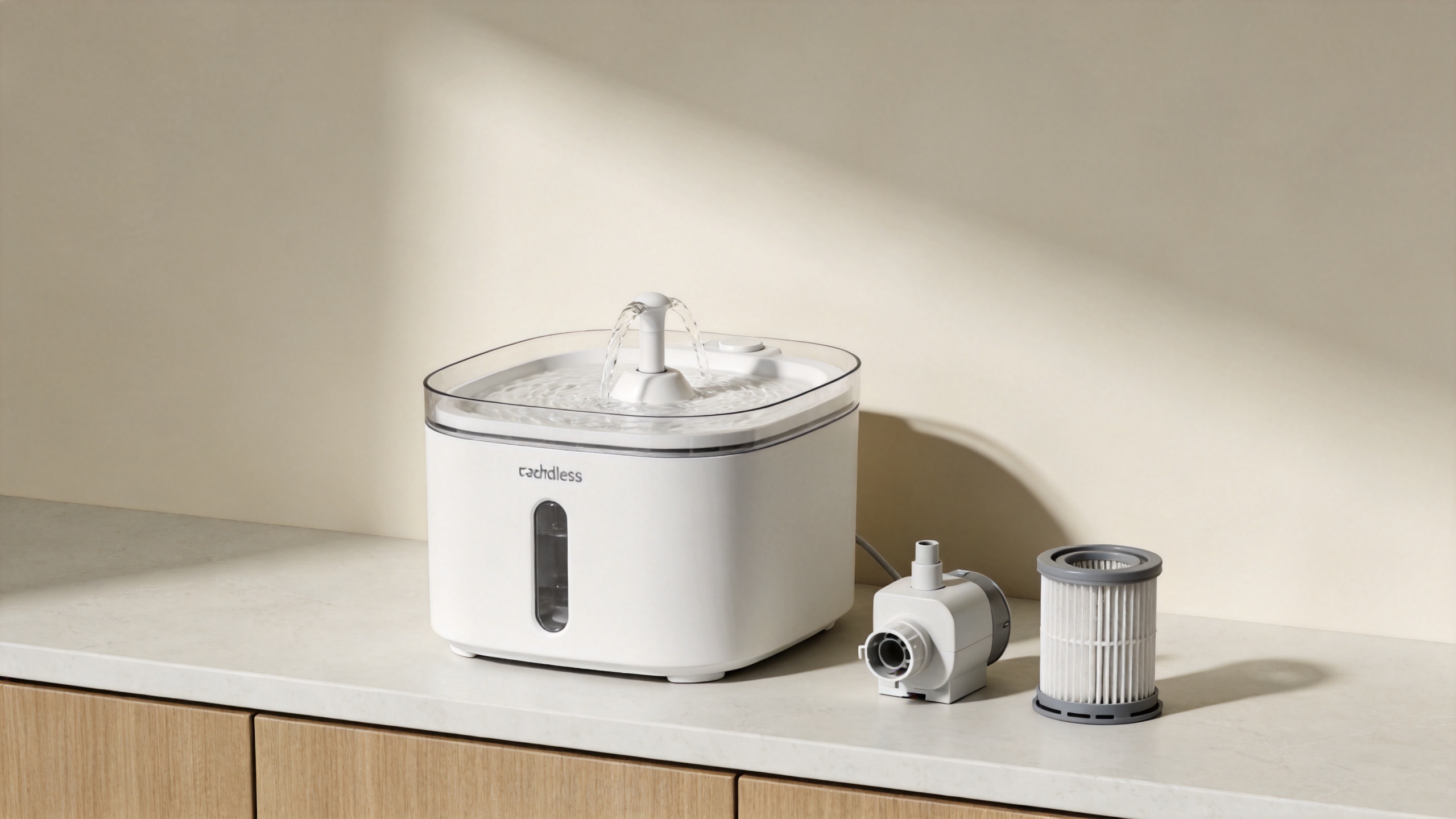
Evaluate flow settings, noise, and your cat’s behavior
Quiet operation matters, but “ultra quiet” is a marketing phrase unless you consider the setting in your own room. Listen for pump vibration, water trickle, and alerts at the level where your cat eats and sleeps. Also check whether the sound changes as the water level falls. A fountain may be acceptable in a kitchen but disruptive in a bedroom or a quiet apartment.
Choose a flow style that fits your cat rather than assuming movement will persuade every cat to drink more. Some cats enjoy a gentle stream; others prefer a calm surface. Introduce the wireless cat water fountain beside the existing bowl, let your cat approach at their own pace, and watch for avoidance, splashing, or stress. If the fountain is not well tolerated, the familiar bowl should remain available.
Check placement and safety before you order
One advantage of a rechargeable cat water fountain is flexible placement. Use that flexibility carefully. Pick a stable, level area away from food, litter, direct sun, and high-traffic routes. In multi-pet homes, make sure a timid cat can reach water without being blocked by another animal.
| Purchase check | Why it matters | What to confirm |
|---|---|---|
| Base stability | Helps limit tipping and spills | Wide footprint, non-slip support, and a level surface |
| Low-water behavior | Protects the pump and alerts you to refill | Indicator or automatic response described in the manual |
| Electrical separation | Reduces splash and charging concerns | Charging guidance and dry-port handling instructions |
| Part availability | Keeps the fountain usable over time | Filters, pump parts, and model-specific support |
Make the final decision with a practical checklist
Before buying, save the model manual and answer these questions: Can I verify real run time in my preferred mode? Can I clean the pump and water channels without frustration? Are replacement filters easy to obtain? Does the capacity match my refill routine? Is there a low-water plan? And will my cat have a familiar alternative while testing the fountain?
A suitable rechargeable cat water fountain is not defined by the largest battery claim alone. It is the one whose charging, capacity, timing, cleaning, and placement requirements you can consistently meet. That practical fit supports cleaner water access and makes the fountain easier to keep in service.