EN
EN
RFID Livestock Traceability: Understanding USDA ADT and Global Compliance Rules
When livestock traceability regulations require official identification, selecting the right rfid livestock tags is not optional — it determines whether your animal records will hold up to an audit or a border crossing inspection. Over the past several years, the regulatory landscape has shifted considerably. The United States, Canada, and the European Union have each moved toward mandatory electronic identification for cattle, sheep, and bison — and the requirements are more specific than many producers and distributors initially expect.
I used to think of official ear tag requirements as just a regulatory checkbox. After observing a livestock movement audit, I realized that a complete electronic identification record is actually an operational asset — it supports disease traceback, protects herd value claims, and can simplify market access in ways that visual-only tagging typically cannot match.
Why Mandatory RFID for Livestock Is Expanding
The push toward mandatory rfid cattle tags is driven by disease response speed. During a disease event, the ability to trace which animals moved where — and when — can determine whether a containment response succeeds or escalates. Governments have concluded that visual ear tags, while still required in most programs, do not provide the scan speed and database connectivity needed for modern traceability.
Managing a herd with visual tags alone can work well for routine operations, until a disease investigation, market rejection, or cross-border movement challenge makes the limits of manual record-keeping apparent. That's when the value of RFID identification becomes concrete rather than theoretical.
What's emerged is a coordinated move by major livestock-producing countries toward official electronic identification systems — each with their own approved tag formats, frequency standards, and program-specific requirements.
USDA ADT Requirements: The 840 RFID Ear Tag Mandate
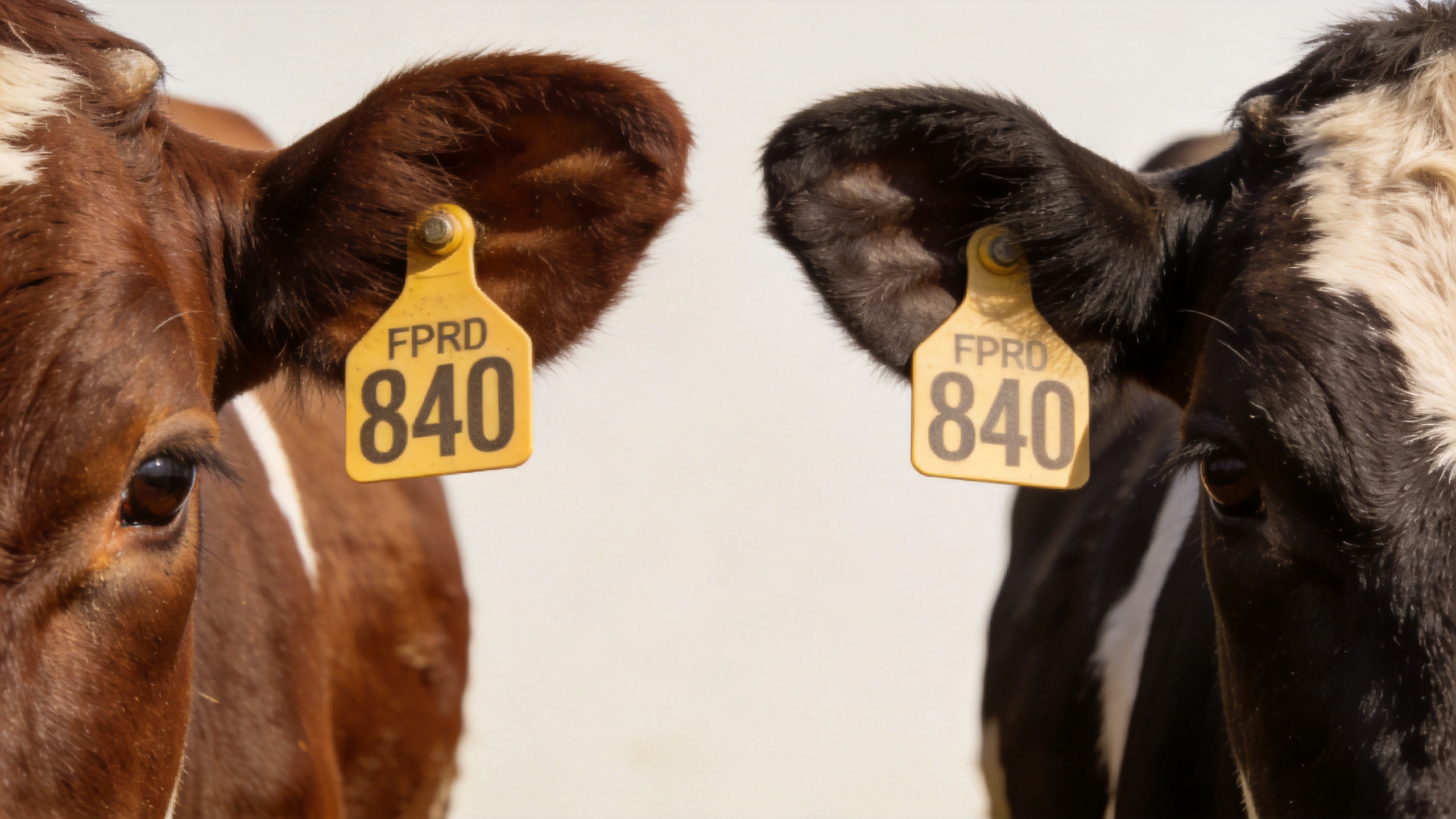
In the United States, the USDA Animal Disease Traceability (ADT) program sets the official framework. A Final Rule became effective November 5, 2024, requiring cattle and bison moving across state lines to carry official electronic identification tags. The rule expands on earlier requirements: dairy cattle had already been subject to the 840 RFID ear tag requirement for interstate movement since January 1, 2023.
At the center of USDA-compliant rfid livestock tags is the Animal Identification Number (AIN), which starts with the country prefix 840 — the United States' country code under ISO standards. The full number is formatted with a space after every third digit (for example: 840 000 123 456 789). Tags that carry this number in an RFID-readable format, approved by USDA-APHIS, satisfy the official identification requirement for interstate cattle movement under the ADT rule.
If your cattle are moving across state lines, choosing eid ear tags for cattle that do not carry a valid 840 AIN in an approved RFID format will create documentation problems at the point of movement — worth confirming with the USDA-APHIS or your state veterinarian before placing a bulk order.
Canada CLTS: CCIA-Approved Tags Required Since 2010
Canada established one of the earliest mandatory livestock RFID programs among major cattle-producing countries. Since July 1, 2010, all cattle in Canada must be tagged with an approved RFID ear tag prior to moving from their location. The program is administered through the Canadian Livestock Tracking System (CLTS), with approved tags sourced through the Canadian Cattle Identification Agency (CCIA).
Canadian law specifically requires CCIA-approved tags that comply with ISO 11784/11785 — the international standard governing RFID transponder coding structure and technical specifications for animal identification. Using non-approved tags does not satisfy the legal requirement, even if the tag carries a number or operates on the correct frequency.
In practice: if your operation or your customers' operations involve Canadian cattle movement, confirming CCIA program approval status is a prerequisite, not a secondary consideration. The rfid cattle tags you source must be both frequency-compatible and program-approved — two criteria that do not automatically come together.
EU Electronic Identification: Mandatory for Small Ruminants, Advancing for Cattle
The European Union has taken a species-by-species approach to mandatory electronic identification. Electronic ID is already compulsory for sheep and goats across EU member states. For cattle, electronic identification has been in active development and consideration at the EU regulatory level, with several member states implementing national programs in advance of a broader EU mandate.
For producers or distributors sourcing rfid livestock tags for EU-destined animals, the relevant verification step is confirming the applicable national regulation and the approved tag list for the specific country of destination — requirements vary by member state and animal category. Choosing a tag without verifying whether it meets the relevant EU or national identification standard can create record-keeping problems at points of market entry, auction, or export.
How to Choose Compliant RFID Livestock Tags
With three distinct regulatory frameworks — USDA ADT, Canada CLTS/CCIA, and EU national programs — selecting the right rfid livestock tags starts with identifying which program your cattle are subject to, and working backward from the approved tag specifications.
- Confirm the applicable program: USDA 840 AIN for US interstate cattle and bison; CCIA-approved ISO 11784/11785 tags for Canadian movement; national or EU species-specific requirements for EU operations.
- Verify frequency compatibility: Most official livestock programs use low-frequency (LF) HDX or FDX-B transponders at 134.2 kHz, compliant with ISO 11784/11785. Confirm the tag operates at the correct frequency for your reader infrastructure.
- Check print durability: Printed numbers on rfid cattle tags that fade before the next scan cycle create cross-check failures and record-keeping gaps. Tags with high-contrast printing and UV-resistant coatings reduce this risk over multiple seasons.
- Require documentation: For bulk orders, request batch inspection reports and, where applicable, program-approval documentation. Approved tags for official programs carry specific visual markers or program logos — confirm these are present before applying tags to animals.
BLUEWORTH's UHF FDX-B 860–960 MHz 840 RFID Ear Tag and livestock identification system UHF RFID TPU Cow Tags are available for operations evaluating RFID-compatible identification options. Confirming program-specific approval status with the relevant authority remains the buyer's responsibility before applying tags under an official program.
What the Regulatory Shift Means for Your Procurement Decisions
The expansion of mandatory rfid livestock tags requirements across North America and Europe changes the calculus of tag procurement in a meaningful way. A tag that satisfies a visual ID requirement but lacks an approved RFID transponder is no longer adequate for regulated movements in the US, Canada, or EU small-ruminant programs. Sourcing decisions need to start from the compliance requirement, not from price alone.
The path from here is direct: identify which program governs your operation's movements, confirm the approved tag specifications from the relevant authority, and source from suppliers who can provide program-compliant tags with supporting documentation. For operations scaling up their identification system or transitioning from visual-only to RFID, this is the right time to establish a supplier relationship that can support both current compliance needs and the evolving international identification landscape.