EN
EN

Questions to Ask a Supplier About Rechargeable Ear Tag Applicators
Buying a rechargeable ear tag applicator is not just a choice between manual and electric force. For a ranch, feedlot, livestock distributor, or animal-identification program, the tool has to work with the tags you buy, fit the way your crew works, and remain serviceable during a busy processing window. A polished product photo cannot answer those questions.
Before you compare prices, ask yourself: do you know exactly which tag styles, animal groups, and daily volumes the tool must handle? If not, any comparison of an electric ear tag applicator is built on assumptions. The supplier conversation should turn those assumptions into written, testable answers.
Start with the ear tag compatibility question
The first question is simple: Which two-piece tag brands, panel sizes, and male/female combinations has this rechargeable ear tag applicator been tested with? Ask the supplier to identify compatible tag formats by part number or provide photos and dimensions of the insert, pin, jaw opening, and tag seating position. “Universal” can be useful marketing shorthand, but it is not a compatibility specification.
Also ask whether the tool supports visual tags, electronic identification (EID) tags, or both. If you use RFID tags now or expect to add them later, confirm that the relevant tag shape can be positioned without damaging its housing. For official-identification programs, verify local approval and format requirements with the relevant authority rather than relying on a general product claim.
- Can the supplier test your actual tag sample before production or shipment?
- Which inserts, adapters, or jaws are supplied for each tag family?
- What happens if a tag sits crookedly or releases before the jaws close?
- Are compatible replacement inserts sold separately?
A supplier that can answer these questions with a sample test, dimensional drawing, or clear setup video reduces a major first-order risk. BLUEWORTH also lists an electric two-piece tag plier with black inserts; when reviewing any matched tool, confirm which inserts correspond to your own tag format rather than assuming the product title covers every configuration.
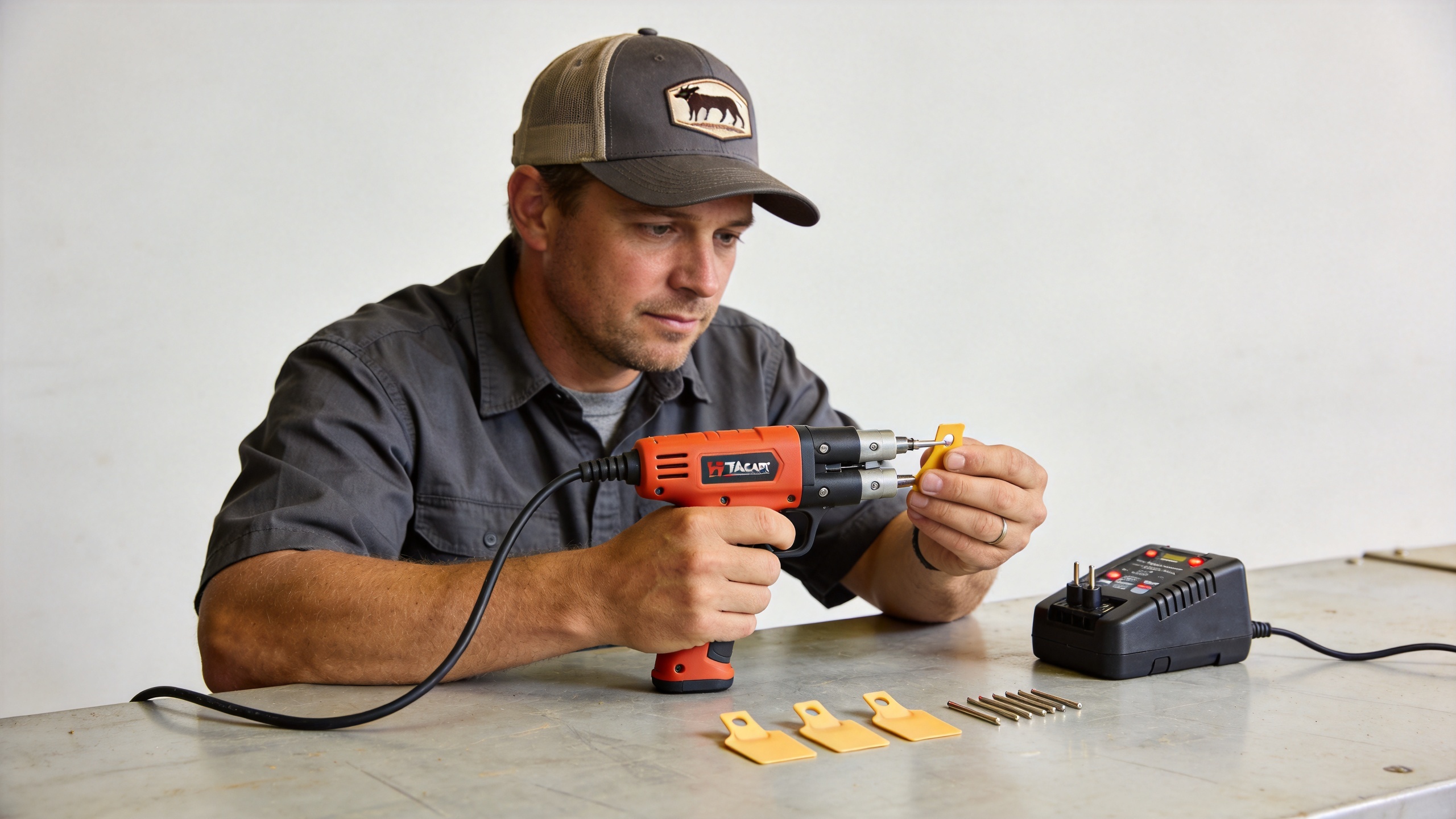
Ask for battery performance under your real workload
Battery claims need context. Ask: How many applications can one fully charged battery complete when used with our tag size and animal type? Then ask how that figure was measured. Tag material, jaw alignment, ambient temperature, operator pace, and the amount of force required can all affect real-world runtime.
Request the battery chemistry, rated capacity, charging time, charger input range, and expected number of batteries included. Many rechargeable applicator listings emphasize lithium-ion batteries and a separate charger; that does not tell you whether the supplied charger fits your destination’s voltage and plug requirements. For cross-border orders, put the plug type, voltage range, and any adapter in the purchase order.
| Battery question | Why it matters |
|---|---|
| What is the stated runtime and test method? | Lets you compare usable applications rather than an unqualified claim. |
| Is a second battery included or available? | Allows charging and tagging to overlap during a long handling session. |
| How long is a full charge, and what indicates charge status? | Helps the crew schedule breaks and avoid an unexpected stop. |
| Can the battery be replaced locally or only through the supplier? | Clarifies downtime and future spare-parts planning. |
Confirm force, placement control, and operator comfort
An electric ear tag applicator can reduce repetitive hand force, but speed alone is not the goal. Ask the supplier for the tool weight, grip dimensions, trigger action, jaw depth, and whether it can be operated safely with gloves. If your crew processes animals in a chute or race, request a short demonstration using the same tag type and a comparable working position.
It is tempting to treat a faster tool as automatically better. In practice, rushed placement can create problems that are not visible until later. Ask what features help keep the male and female components aligned, whether the jaw stops at a consistent depth, and how the tool behaves if the trigger is released early. The supplier should also explain routine pin inspection and safe replacement.
For high-volume work, ask for a practical recommendation on spare pins and wear parts per season. A replacement pin is a small component, but an unavailable one can halt a tagging session. Confirm the part number, material, lead time, price, and whether changing it requires special tools.
Request a maintenance and failure-response plan
Do not wait for a jam or weak punch to discover the service process. Ask for an operating manual, cleaning guidance, lubrication requirements if any, storage temperature recommendations, and a troubleshooting chart. The useful question is not “Does it need maintenance?” but “What does the operator inspect before each shift, after each shift, and before seasonal storage?”
Ask the supplier to describe common failure modes: reduced punching force, intermittent power, poor jaw alignment, damaged pins, battery charging faults, and insert wear. For each one, request the likely cause, the parts needed, and the expected response time. If the tool is intended for a distributor order, ask whether spare-part kits can be packed with each carton and whether product documentation can be supplied in your market’s language.
Turn samples and quality checks into purchase conditions
For a first order, a sample is more useful when it follows a defined test plan. Send the supplier your tag sample and ask them to document the compatible insert, the battery supplied, and the tag orientation used. On receipt, test the rechargeable ear tag applicator on a controlled number of tags before a full-herd session. Inspect alignment, smooth closure, pin condition, and repeatability.
For larger orders, ask whether the supplier can provide a pre-shipment checklist covering tool model, insert color or code, battery count, charger specification, spare pins, packaging, and serial or batch identification. That record makes it easier to resolve an issue without relying on memory or a generic photo weeks later.
- Approve the tool-and-tag combination with a sample.
- Put the agreed accessories and electrical configuration in the order confirmation.
- Define the initial inspection and test procedure before delivery.
- Keep a contact route for technical questions and replacement-part orders.
Cover commercial terms for bulk and distributor orders
Decision-stage buyers should ask about more than unit price. Confirm minimum order quantities, sample charges, volume tiers, production lead time, shipping method, carton contents, warranty terms, and how a defective unit is handled. If you sell to other farms, add questions about private-label packaging, instruction sheets, spare-parts bundles, and ongoing supply availability.
You could argue that a smaller operation does not need a detailed service plan. That is fair when the tool is used rarely and a backup is readily available. But if the tool is needed for a time-sensitive calving, movement, or processing event, a clear battery-and-parts plan can matter more than a small upfront saving.
A supplier question list you can send today
Use this concise list in your inquiry:
- Which ear tag models and inserts are confirmed compatible with this rechargeable ear tag applicator?
- Can you test our tag sample and share setup photos or video?
- What are the battery type, runtime test conditions, charging time, plug type, and charger voltage range?
- How many batteries, pins, inserts, and other wear parts are included?
- Which replacement parts can be ordered separately, and what are their lead times?
- What inspection, cleaning, and storage steps do you recommend?
- What warranty, technical support, and defective-unit process apply to our market?
- For a bulk order, can you confirm accessories, packaging, and batch details on the proforma invoice?
Put the answers into a purchase record
Use one line per item in the quotation so your team can compare like for like. For a rechargeable ear tag applicator, record the model, approved insert, battery count, charger plug, runtime test conditions, spare-pin part number, warranty contact, and sample-test outcome. For an electric ear tag applicator, add tag-family compatibility, maintenance steps, replacement-part lead time, and the accessories packed with every unit.
Ask the supplier to confirm whether each rechargeable ear tag applicator is inspected before shipment and whether a second battery or service kit can be included. For a distributor, document the electric ear tag applicator manual, carton labeling, and after-sales contact as well. This small record prevents a generic product description from becoming an expensive assumption at delivery.
Make the final choice on evidence, not labels
A suitable rechargeable ear tag applicator fits your approved tags, keeps the work moving, and has a clear path for batteries, pins, and technical support. Ask for compatibility evidence, charge information tied to real conditions, and a written list of included and replaceable parts. That approach gives your team a dependable buying decision instead of a tool that only looks suitable in a catalog.