EN
EN
Personalized Cattle Ear Tags: Bulk Custom-Numbered and Logo Tag Ordering Guide
As someone who has worked through the procurement side of large cattle identification programs, I've seen the same mistake made repeatedly: buyers comparing personalized cattle ear tags on unit price alone while ignoring every downstream cost in the equation. Tags that fade before the next scan cycle don't just create management headaches — they translate into field workers double-tagging animals, record-keeping rework, and potential traceability gaps at precisely the moments when accurate identification matters most. For ranchers and distributors placing bulk custom orders, what the lowest-priced option costs per tag is rarely the right metric. The number that matters is cost-per-retained-readable-tag at the end of a full grazing season.
This guide covers the four decisions that most directly affect whether a bulk personalized cattle ear tags order delivers value: what to customize, which marking method to specify, how to structure MOQ and volume pricing, and what lead time and packaging terms to confirm before production starts.
Customization Options: Numbers, Logos, and Color Coding
The first decision in any personalized cattle ear tags program is what information to put on the tag. Factory-direct manufacturers typically support three customization layers on a single order:
- Sequential serial numbers — Specify a starting number and the sequence range your herd management system requires. Numbering accuracy at the factory level eliminates the manual re-sequencing work that shows up when tags are delivered out of order.
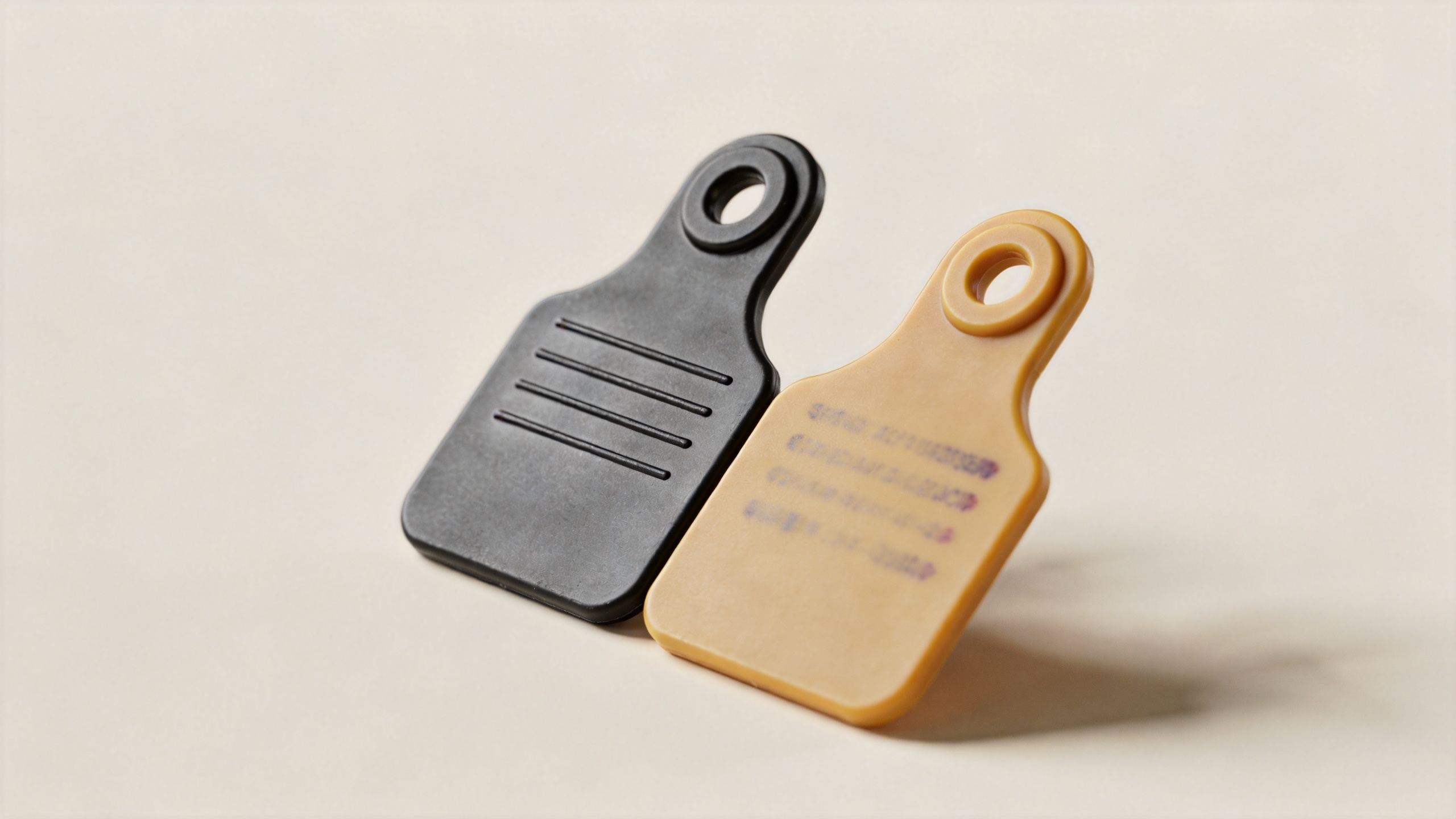
- Farm logo or brand mark — Your logo can be laser-engraved or printed onto the tag face. Laser-engraved logos are permanent; printed logos work for short-season programs or replacement cycles under 18 months where some readability degradation is acceptable.
- Color coding — Most manufacturers offer 8–12 standard colors. Color-coding schemes are commonly used to separate age cohorts (year-of-birth classes), management groups (vaccinated, breeding cohort), or ownership batches for distributors fulfilling multiple client orders simultaneously.
If your operation is in a high-UV region or uses pour-on chemical treatments near the head and ear area, confirm that the tag material is UV-stabilized polyurethane before finalizing the spec. This directly affects how long the printed information on your personalized cattle ear tags stays legible across a full outdoor service cycle.
Laser Engraving vs. Ink Printing: Choosing the Right Marking Method
The marking method you specify on a personalized cattle ear tags order shapes your tag's long-term service life and total replacement cost. Laser engraving and ink printing perform very differently under field conditions — the right choice depends on how your operation actually works, not on which method is newer or more expensive.
| Factor | Laser Engraving | Ink Printing |
|---|---|---|
| Durability mechanism | Marks burned permanently into tag material; cannot be wiped or dissolved | Surface application; readability depends on UV resistance and chemical exposure |
| Chemical resistance | Unaffected by pesticides, insecticides, and pour-on treatments | Ink lifts or fades rapidly on tags exposed to chemical applications |
| Long-term readability | Maintains contrast through the tag's full service life | Can become unreadable before the next annual identification scan |
| Cost per unit | Higher due to processing time | Lower at standard production volumes |
One practical rule: if your management protocol involves any chemical application in the head and ear area — fly tags, pour-on insecticides, or chemical ear treatments — laser engraving is not a premium upgrade. It is the only marking method that will hold. Ink printing on chemically treated tags routinely becomes illegible within weeks of application, which is exactly the point at which you do not want to be re-ordering and re-tagging under time pressure.
For closed operations with controlled environments, shorter replacement cycles, and no chemical protocols, high-contrast ink printing with a UV-resistant coating panel can maintain readability at significantly lower per-unit cost. If your priority is minimizing first-order cost and your replacement tolerance is flexible, that trade-off may be worth specifying — but confirm the UV coating specification explicitly with the factory before placing the order.
MOQ, Volume Pricing, and the Sample-to-Bulk Pathway
Factory-direct pricing for personalized cattle ear tags is structured around production batch economics, not per-item catalog pricing. Understanding how manufacturers set minimum order quantities and volume tiers changes how you calculate the true cost of a custom identification program.
A realistic planning baseline for a factory-direct custom cow ear tags order:
- MOQ: 500–1,000 pieces for standard customization (color + serial number range)
- Sample lead time: 5–7 business days for a pre-production sample batch to verify print quality and applicator fit
- Bulk production lead time: 15–25 days after sample approval, depending on customization complexity and current factory schedule
- Volume tier breaks: Per-unit price typically steps down at 1,000, 5,000, and 10,000-piece thresholds — the relevant factor to evaluate if you are sourcing for a distributor account rather than a single operation
Before committing to bulk production, request a sample batch. Testing tag compatibility with your existing applicator tools before a full production run is standard practice, not an unusual ask. Discovering an applicator incompatibility after receiving a 5,000-piece order creates a very different problem than catching it during a 50-piece sample evaluation. A manufacturer that supports pre-production sampling gives buyers a direct quality resolution path — instead of working through a reseller intermediary who cannot authorize a factory correction.
Bulk Order Lead Times and Packaging Specifications
Lead time and packaging terms affect receiving, storage, and distribution operations for personalised cattle ear tags — particularly for distributors managing orders across multiple end customers with different serial ranges and color codes.
Standard bulk packaging configurations:
- Bulk poly bag: 100–500 tags per inner bag; most cost-effective for single-operation use where tags are pulled and applied directly
- Inner box with outer carton: 50–100 tags per inner box; appropriate when tags need to be separated by color batch or serial range for sub-distribution
- Custom outer carton labeling: Some manufacturers support carton-level labeling with your order number, serial range, or brand mark — useful for distributors maintaining inventory control across multiple client batches in a single shipment
Confirm inner-count specifications in writing before production starts. Discrepancies between expected and actual inner-bag count compound across large orders and create reconciliation issues at receiving. A factory that documents production lot traceability can address batch-level quality concerns efficiently — particularly important if you are evaluating a new supplier before scaling your personalized cattle ear tags order volume.
Placing Your Custom Order: What to Prepare
A structured initial inquiry reduces revision cycles and shortens the path from inquiry to approved sample for any personalized cattle ear tags program. Provide the following when contacting a manufacturer:
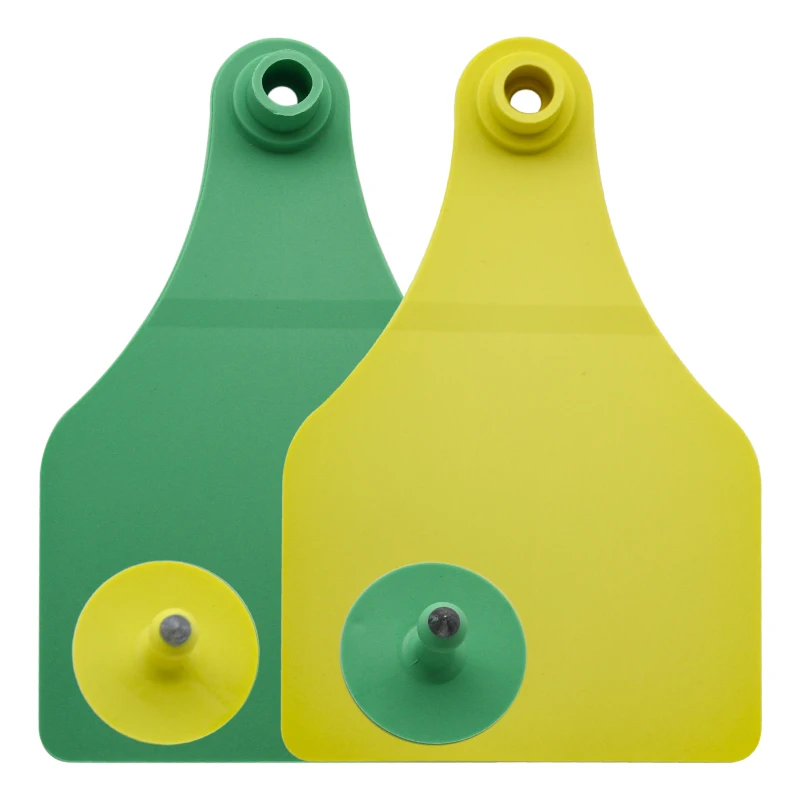
- Tag size and style (super maxi two-piece, standard, mini, or button style)
- Color specification — standard color name or, for precise color matching, a Pantone or RAL reference
- Marking method preference — laser engraving or ink printing
- Serial number range — start number, end number, and whether sequential or non-sequential
- Logo file — vector format (AI, EPS, SVG) preferred for consistent reproduction across different tag sizes
- Total quantity by color and serial block
- Packaging preference — bulk bag, inner box, or custom carton labeling
- Target delivery date, factoring in sample approval time
BLUEWORTH manufactures TPU and polyurethane cattle ear tags with two-piece locking mechanisms engineered for consistent hole-punch compatibility across standard applicator tools. Their product line includes the Super Maxi Size Two-Piece Cow Ear Tag in 11 standard colors — available blank for buyer-side imprinting or specified as a custom OEM order with your serial numbers and logo. For operations requiring flexible TPU construction to reduce long-term ear tissue stress, the TPU Animal Ear Tag line is available in volume configurations. Contact BLUEWORTH at blueworthtags.com to discuss customization requirements, MOQ, and delivery timeline for your next personalized cattle ear tags order.