EN
EN

LF vs. UHF RFID Ear Tags for Cattle: How to Choose the Right Frequency
As someone who has worked with animal identification systems across multiple herd management programs, I've seen firsthand how the right rfid ear tags for cattle can reduce record-keeping errors and improve traceability. And the decision that trips up more cattle producers than almost any other? Choosing between LF and UHF frequencies.
Before you decide, ask yourself: does your operation primarily need individual animal identification at the squeeze chute, or batch inventory scanning at the gate? The answer often determines your frequency choice before you even look at a product catalog.
With USDA now requiring RFID ear tags for beef and dairy cattle moving interstate as of January 2023, the question of which frequency to select has moved from optional planning into active procurement territory. This guide breaks down both options so you can match your choice to your operation's actual workflow.
LF RFID Ear Tags: Individual Animal Management at Close Range
LF rfid ear tags for cattle operate at 125–134.2 kHz and follow the ISO 11784/11785 standard—the same standard that underpins USDA-approved official identification tags. For operations subject to interstate movement requirements, that compliance alignment matters for procurement decisions.
Read range: Approximately 12–36 inches (30–90 cm) with a handheld wand or squeeze-chute panel reader.
Water and mud performance: Excellent. LF signal is largely unaffected by water, tissue density, and mud, which holds up well in wet climates and high-contact feedlot conditions.
Primary use case: Individual animal processing at the chute, pregnancy testing, health event recording, and compliance documentation for national identification programs.
If your operation is in a wet or muddy environment, LF's performance advantage over UHF under those conditions is real and repeatable. This is why LF remains the backbone of most official national identification programs in North America.
The trade-off is range. If your workflow requires capturing animal IDs as a group moves through a gate or loading alley at speed, the 12–36 inch read window requires animals to slow or stop—adding real handling time across a large herd during a loading event.
UHF RFID Ear Tags: Long-Range Batch Scanning for Scale
Ultra-high-frequency RFID operates at 860–960 MHz, using the ISO 18000-6C (EPC Gen2) standard. This is the frequency range behind most high-throughput inventory RFID systems outside of livestock—and the performance profile reflects that origin.
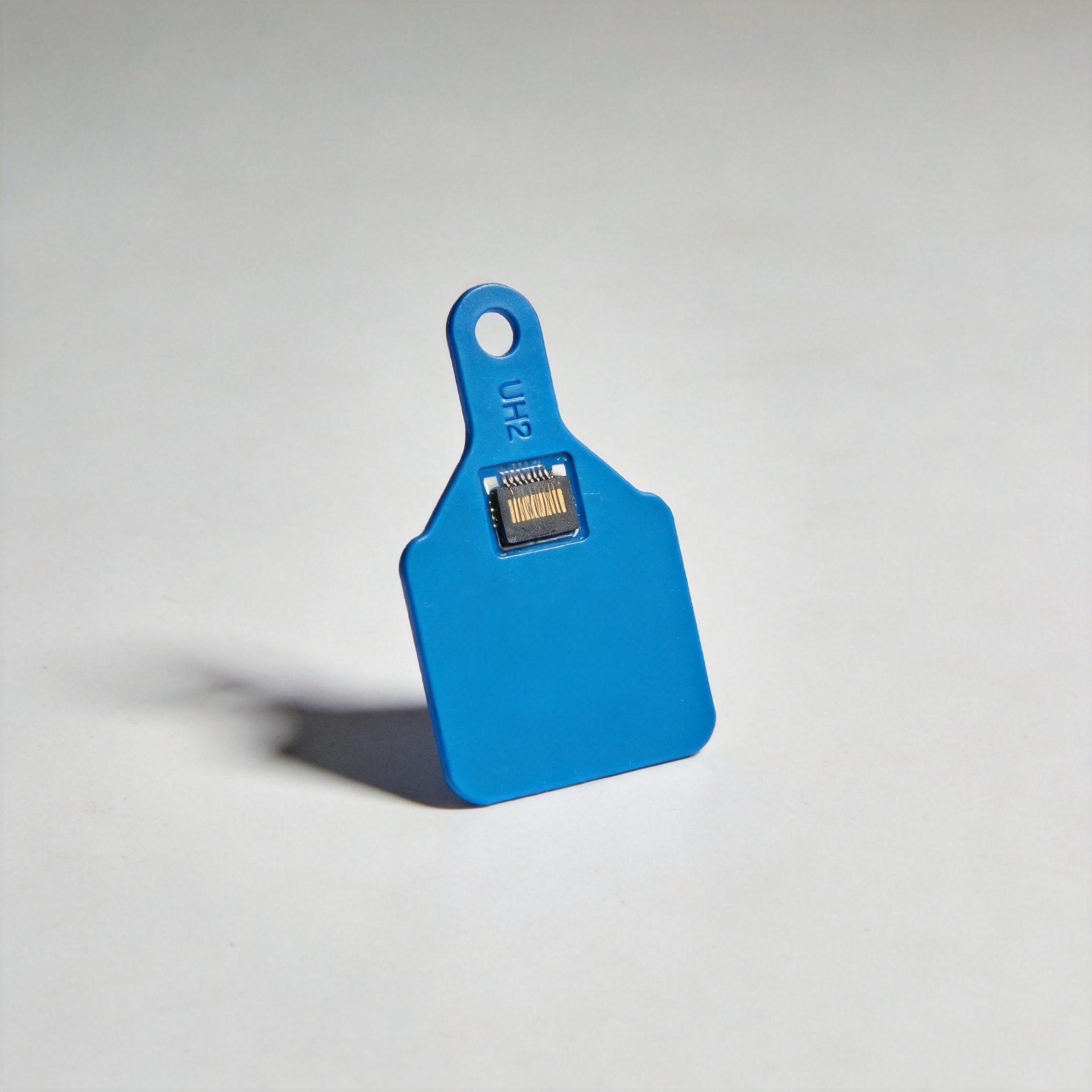
Read range: 10–20 feet (3–6 meters) with a fixed panel reader; performance varies with reader placement, antenna configuration, and environmental conditions.
Water and mud performance: Reduced. UHF signals are partially absorbed by water-dense tissue and liquid environments, which can lower read consistency in wet conditions.
Primary use case: High-throughput loading operations, automated gate readers, large-scale herd inventory, and batch data capture without individual animal handling pauses.
Managing a herd of 300 head with LF tags worked fine until the operation expanded to automated gate scanning during loading. That's the point when switching to UHF-based rfid cow tags started making sense, not because LF was failing, but because the operation had grown beyond what close-range scanning could manage efficiently.
On a 500-head operation, a gate reader capturing 20 animals passing in 10 seconds makes UHF's longer read range worth the system investment. For smaller operations without automated gate infrastructure, that argument becomes harder to justify on unit economics alone.
LF vs. UHF: Side-by-Side Comparison
| Feature | LF (134.2 kHz) | UHF (860–960 MHz) |
|---|---|---|
| Read Range | 12–36 inches (30–90 cm) | 10–20 feet (3–6 m) |
| ISO Standard | ISO 11784/11785 | ISO 18000-6C (EPC Gen2) |
| Water / Mud Performance | Excellent | Reduced |
| USDA Official ID Approval | Yes (most programs) | Program-specific – verify before purchase |
| Tag Cost Range | $1.50–$4.00 per tag | $2.00–$5.00 per tag |
| Reader System Cost | Lower | Higher |
| Workflow Fit | Individual ID at chute, compliance records | Batch gate scanning, high-throughput inventory |
Selecting the Right Frequency by Operation Type
The tradeoff between LF and UHF rfid livestock tags isn't just about upfront cost—it's really about whether your operation has the throughput scale or automation infrastructure that justifies the reader system investment UHF requires. When selecting rfid ear tags for cattle at volume, understanding that tradeoff upfront prevents costly reader infrastructure mismatches later.
- Cow-calf and small operations (under 200 head): LF is typically the right starting point. Compliance-ready for official programs, lower reader system cost, handles wet field conditions well, and sufficient for chute-based individual animal management workflows.
- Mid-size commercial operations (200–800 head): Evaluate whether your workflow currently involves or is moving toward automated gate or alley scanning. If yes, UHF infrastructure pays back more as throughput grows. If not, LF continues to serve the identification function without the additional system overhead.
- Large feedlots and commercial operations (800+ head): UHF's batch read capability becomes a genuine operational tool at this scale. The reader infrastructure cost is offset by time savings at loading, weighing, and sorting events that occur repeatedly across the production cycle.
- Dairy operations: Individual animal health tracking and integration with dairy management software favor LF's reliable close-range reads, though specific high-throughput dairy workflows occasionally incorporate UHF for defined workflow points.
UHF RFID Cattle Tags from BLUEWORTH
For operations moving toward UHF-based identification, BLUEWORTH manufactures UHF RFID cattle ear tags in the 860–960 MHz range with TPU construction for field durability. The livestock identification system UHF RFID TPU Cow Tags and the BLUEWORTH UHF FDX-B 860~960MHz 840 RFID Ear Tag are available through the BLUEWORTH catalog for operations evaluating UHF tag options.
For operations also reviewing reader hardware, the BLUEWORTH C5 UHF RFID Ear Tag Handle Reader supports handheld UHF scanning with QR code capability—useful for operations bridging physical RFID identification with digital herd management records.
Field deployments of UHF RFID ear tags show a recurring issue: tags placed too close to the ear margin see reduced read consistency, regardless of the tag's overall quality spec. Placement depth matters as much as frequency selection.
Matching Frequency to Your Operation
The right rfid ear tags for cattle frequency is the one that fits your reader infrastructure, your compliance requirements, and your handling workflow—not simply the one with the longer read range on the spec sheet.
LF remains the baseline for compliance-first, close-range individual animal management across most North American cattle operations. UHF pays off when your operation has the throughput and the automation infrastructure to use that longer read range efficiently. For most operations currently evaluating rfid cow tags or rfid livestock tags for the first time, LF is the lower-risk starting point—with a clear upgrade path if batch gate scanning becomes a workflow priority.
For procurement teams comparing supplier options across either frequency, BLUEWORTH's factory-direct pricing and multi-format RFID product range provides flexibility across visual and electronic identification requirements at competitive volume pricing.