EN
EN

How to Select an Electric Ear Tag Applicator for Two-Piece Tags
Choosing an electric ear tag applicator is a purchasing decision, not simply a choice of a faster pair of pliers. For cattle, sheep, goat, and other livestock operations, the tool must match the two-piece tag system, the operator’s daily workload, and the available power setup. An RFID scanner device may be part of an electronic-identification workflow, but it is different from the applicator that physically installs the tag. Keeping those functions separate helps buyers build a practical tagging process.
Start with the tag, then work backward to the tool. The most suitable electric applicator is the one that seats the matching male and female components cleanly, is comfortable for the team to use, and can be supported in the country where it will operate. If an RFID scanner device will be used to verify electronic IDs after application, plan that handoff before ordering.
Confirm Compatibility With Your Two-Piece Ear Tags
Two-piece ear tags use a male pin and a female button or panel. The applicator’s pin, jaw opening, alignment, and retaining parts need to suit that construction. Do not assume that a tool promoted for one-piece tags will correctly install a two-piece tag. A mismatch can cause incomplete closure, difficult positioning, or unnecessary rework.
Ask the supplier for the supported tag style, the intended animal species, and clear photos of the loaded tool. If your program combines visual tags with electronic identification, confirm whether the tag itself carries the electronic component and whether your RFID scanner device reads the applicable frequency. The applicator does not replace an RFID scanner device; one installs the tag and the other confirms or captures the ID.
- Check the exact two-piece tag format before purchase.
- Verify that replacement pins or wear parts are available.
- Request a sample or trial run with your selected tag when possible.
- Keep the application tool and RFID scanner device requirements on the same procurement checklist.
Match the Power System to the Work Site
Electric tools can use different power arrangements. Some tools use rechargeable batteries, while others are supplied with a charger designed for a specified mains voltage and plug. Review the charger label, plug standard, battery quantity, charging time, and whether a compatible local power solution is needed. A 110V USA-style plug, for example, should be checked against the destination’s site power before it is added to a farm or distributor order.
For mobile crews, battery continuity matters as much as drive force. Decide who will charge batteries, where spare batteries will be kept, and how the team will protect electronics from moisture and dust. If records are captured in the field, arrange charging and storage for the RFID scanner device as well. A reliable RFID scanner device is helpful only when it is available at the point of tagging.
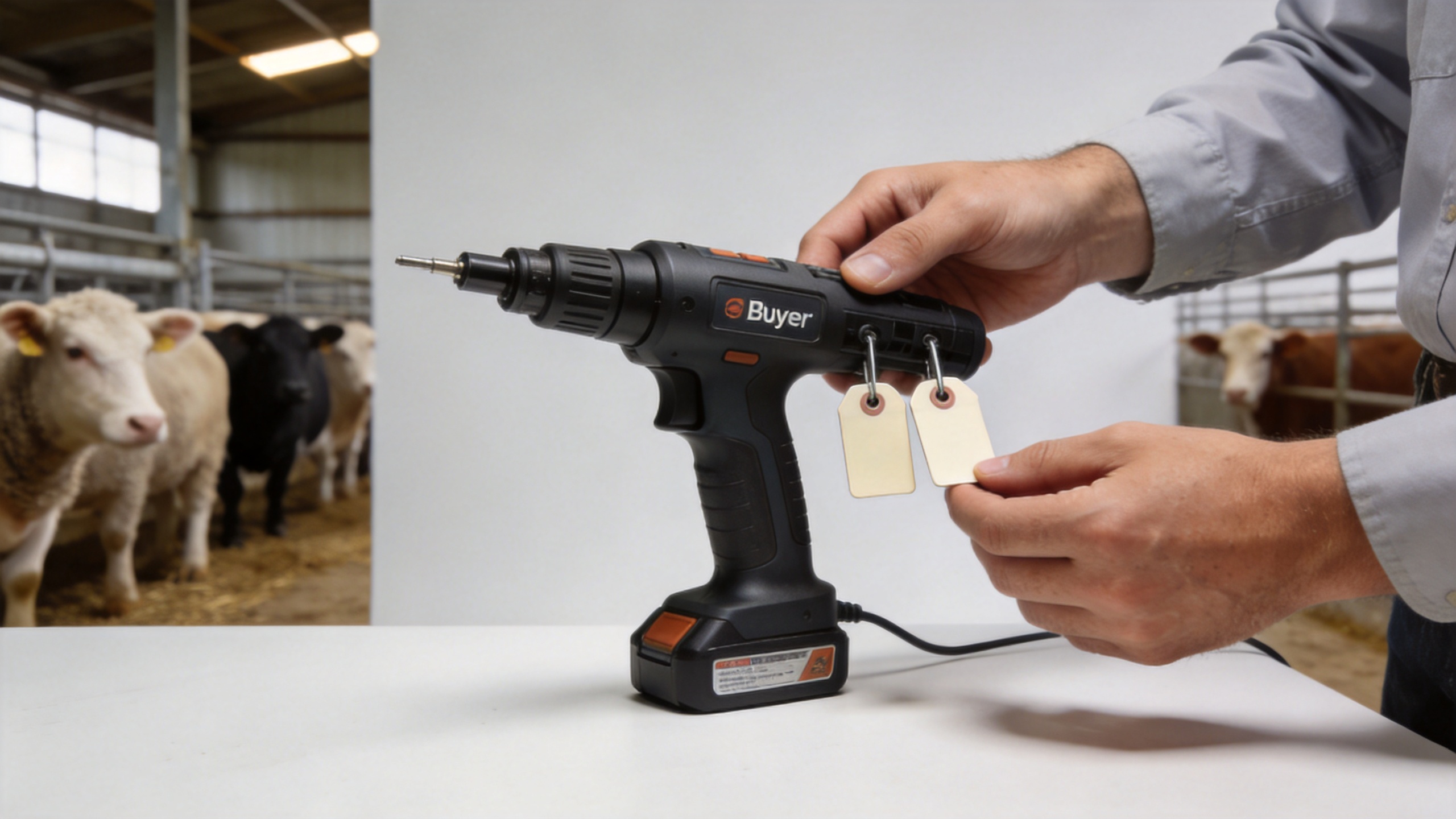
Compare Ergonomics, Control, and Throughput
Electric assistance can reduce the repeated hand force associated with manual tagging, especially during larger processing sessions. That does not remove the need for trained handling, correct tag placement, and a calm workflow. Look at handle balance, trigger placement, grip size, loaded weight, and how easily an operator can see the tag alignment point.
For a purchasing comparison, ask operators to test the full motion: load the two pieces, position the ear safely, activate the tool, inspect the closure, and record the identification. If the next step is electronic verification, the RFID scanner device should be easy to reach without interrupting animal flow. This is where an RFID scanner device can improve record accuracy, while the applicator supports consistent installation.
| Evaluation area | What to verify | Why it matters |
|---|---|---|
| Tag fit | Two-piece tag style, pin and jaw alignment | Helps avoid poor closure or damaged components |
| Power | Battery, charger voltage, plug type, spare-battery plan | Supports uninterrupted field work |
| Handling | Grip, trigger response, weight, sightline | Influences repeatability over long sessions |
| Data flow | RFID scanner device compatibility and recording method | Connects identification to the animal record |
Build a Complete Identification Workflow
Buyers sometimes focus on the electric tool and leave data capture until later. A stronger approach is to map each handoff: tag stock is checked, the two-piece tag is loaded, the tag is applied, the position is inspected, and the identification is recorded. Where electronic tags are used, an RFID scanner device can read the tag according to its supported technology and send the result to the farm’s chosen record process.
Before deployment, test a small batch under normal working conditions. Confirm that the RFID scanner device reads the tags you have actually applied, that the operator can distinguish visual numbers when needed, and that the records are associated with the correct animal. This trial is more useful than relying on a generic claim about read range or speed, because tag type, reader specification, animal movement, and workflow all affect outcomes.
Evaluate the Supplier Beyond the Tool Listing
For B2B buyers, a product listing is only the beginning. Ask about lead time, packaging for spare batteries or chargers, documentation, replacement parts, and communication during a compatibility issue. Factory-direct sourcing can simplify discussions about recurring orders and volume planning, but it does not eliminate the buyer’s need to confirm the actual configuration.
For a product option that should be checked against your own two-piece tags and destination power setup, review the Electric Ear Tag Applicator One-piece Tag Plier 110V for Two-piece Type USA Standard Plug Livestock Tagging Tool. The listing name identifies a 110V USA-standard plug and two-piece-type use; buyers should still confirm current specifications, tag fit, and included accessories before ordering.
Use This Pre-Purchase Checklist
- State the exact two-piece tag model and animal use case.
- Verify applicator fit, jaw geometry, and replacement-part availability.
- Confirm charger voltage, plug standard, batteries, and field charging plan.
- Assess comfort and safe operation with the people who will use the tool.
- Where electronic IDs are involved, confirm the RFID scanner device matches the tag technology.
- Run a small operational test that includes the RFID scanner device, record capture, and inspection process.
- Document support, reorder, and spare-part expectations with the supplier.
In short, select the applicator for the mechanical job it must do: accurately install your two-piece tags in your real working environment. Select an RFID scanner device for identification capture, not as a substitute for the tagging tool. When compatibility, power, ergonomics, and records are evaluated together, the result is a more dependable livestock identification workflow.