EN
EN

How to Choose a Cat Water Fountain for Different Household Needs
A cat drinking fountain is not a one-size-fits-all purchase. The right choice depends less on a long feature list and more on your home: how many cats drink there, how often someone can clean the unit, where it will sit, and whether a power cord is practical. A quiet, compact cat fountain can be a good match for one cat in a small apartment; a busy multi-cat home may need more capacity, easier access, and a maintenance routine that is simple enough to keep.
When comparing options, start with the household rather than the product. That small shift prevents a common mistake: buying the largest or most technical model only to find that it is awkward to wash, too loud for its location, or difficult for a timid cat to approach.
Start with your household’s drinking pattern
Think about the number of pets, their routines, and who is responsible for refilling and cleaning. A cat drinking fountain should make fresh water easier to offer, not add a task that gets postponed.
| Household situation | What to prioritize | What to check before buying |
|---|---|---|
| One cat, small apartment | Compact footprint and low operating sound | Whether the water flow is gentle and the cord reaches a safe outlet |
| Two or more cats | Useful reservoir capacity and more than one comfortable drinking position | How easily bowls, pump, and intake surfaces can be cleaned |
| Long workdays or short trips | A clear water-level view and dependable refill routine | Low-water behavior, reservoir access, and the manufacturer’s care instructions |
| Noise-sensitive home | Quiet pump design and stable placement | Sound at both full and lower water levels |
| Senior, shy, or cautious cat | Easy entry, predictable flow, and a stable base | Bowl height, splash pattern, and whether the cat can approach from the side |
Choose capacity for refill habits, not just the number on the box
More capacity can reduce refill frequency, especially in a multi-cat household. But a bigger reservoir is only helpful if it remains easy to empty and wash. For a one-cat home, a smaller cat fountain may be easier to maintain. For several pets, look for enough usable water and enough access points so that one cat does not block another.
Capacity is also a placement decision. A large unit can be inconvenient on a narrow kitchen counter or in a laundry room where it may be bumped. If you prefer a larger reservoir, make sure you can lift it comfortably to the sink without spilling. In practice, that convenience matters more than choosing the highest-capacity model available.
Do not use capacity as a reason to leave water unchanged for too long. A sensible routine is to refresh water regularly and follow the product manual for cleaning and filter replacement. General maintenance guidance commonly suggests daily water replacement, a weekly clean, and filter changes every two to four weeks, but your fountain’s instructions should take priority.
For multi-cat homes, prioritize access and cleanability
A multi-cat setup has two recurring pressures: more drinking traffic and more hair or debris reaching the fountain. The more suitable fit is usually not simply a bigger tank. It is a design with a bowl area that lets more than one cat drink comfortably, removable parts that can be reached without tools, and a pump compartment you can inspect.
When you compare a cat drinking fountain for several pets, ask these practical questions:
- Can each cat approach the water without crowding another cat?
- Is the intake protected from floating hair, and can the guard be rinsed easily?
- Can you remove the pump and clean its small parts without a complicated teardown?
- Is the water-level indicator visible from where you normally pass by?
- Will replacement filters be practical for your ongoing routine?
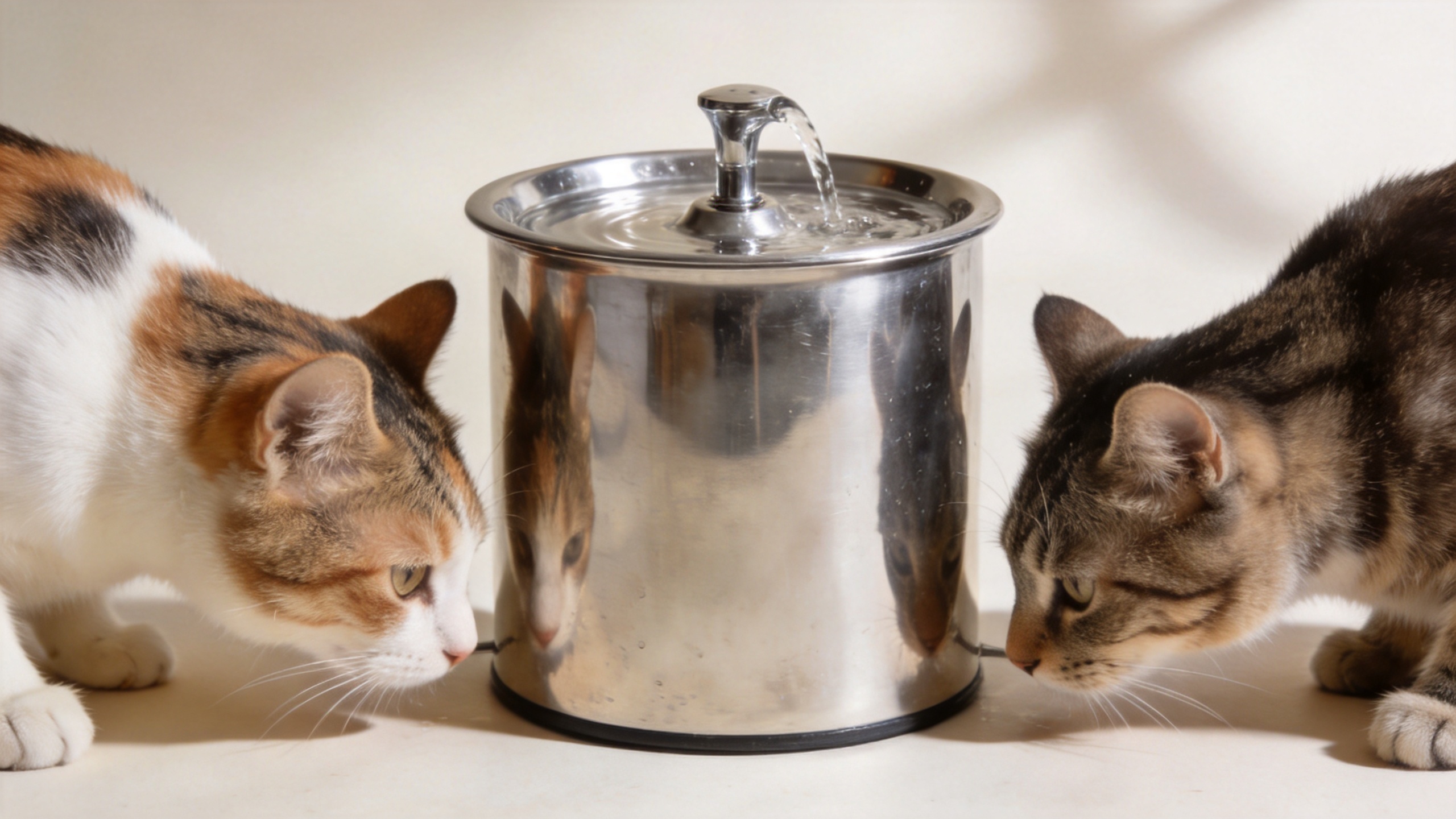
A 4L model may suit a household that wants a larger reservoir, but confirm the actual layout and maintenance requirements before treating capacity as the deciding feature. For example, you can review this automatic pet water fountain with a 4L capacity alongside your own space, cleaning schedule, and pet count.
Put noise and power choices in the context of where the fountain lives
Quiet operation is important when the fountain will sit near a bedroom, home office, or a cat’s preferred resting area. But “quiet” is not just a pump specification. Waterfall height, vibration against a hard floor, and low-water operation can all change what you hear. Place the unit on a stable, level surface and use a mat if it helps control movement and splashing.
For a cordless or battery-supported cat fountain, consider how you will remember charging and how the unit behaves as battery level falls. For a plug-in model, plan the cable route first. The outlet should be accessible without creating a trip hazard or putting the connection near repeated splashes. If your cat is wary of new objects, begin with a gentle setting and allow time for exploration rather than forcing the change overnight.
Make cleaning effort your non-negotiable criterion
It is tempting to focus on a sleek exterior, but the parts you cannot easily see determine whether the fountain stays pleasant to use. Before choosing a cat fountain, inspect photos or instructions for the pump cover, intake, filter holder, spout, seams, and reservoir opening. The easier each part is to reach, the more likely the cleaning routine will happen consistently.
I was going to say that material is the main cleaning decision—but actually, access is at least as important. Stainless steel, ceramic, and plastic all have trade-offs in weight, cost, appearance, and care. A well-designed unit in any of these materials is easier to live with when it comes apart quickly, sits securely during washing, and has parts you can reassemble correctly.
Use this quick pre-purchase checklist:
- Look for removable, washable components rather than a sealed-looking body.
- Check the recommended cleaning and filter schedule before you order.
- Confirm that you can buy the correct replacement filters and pump parts when needed.
- Choose a location with enough room to refill and clean without moving other items.
- Keep a separate still-water bowl available while your cat adjusts or whenever the fountain is being cleaned.
Match the water flow to your cat, not to a trend
Some cats are curious about moving water; others prefer a calm surface. A cat drinking fountain with adjustable or gentle flow gives you more room to observe what your cat actually uses. Watch from a distance during the first few days. If your cat avoids the unit, tries to drink only from the edge, or appears unsettled by the sound, reduce the flow if possible or change the placement.
For a cautious cat, stable footing and a low-splash drinking area can matter more than extra features. For an energetic home with several cats, a broader basin and better access may be more useful. The goal is not to declare one style universally right for every home; it is to remove the friction that keeps your household from using and maintaining the fountain well.
Use a short cat drinking fountain comparison worksheet
Before ordering a cat drinking fountain, write down the answers that matter in your home. Is this cat drinking fountain for one cat or several? Will the cat fountain sit beside a quiet bedroom, in a busy kitchen, or near a protected outlet? Can you take the cat drinking fountain apart every week without avoiding the job?
For each cat drinking fountain on your shortlist, compare reservoir access, pump access, and the number of comfortable drinking positions. A cat fountain that is easy to rinse may be a better fit than a larger cat drinking fountain with hidden crevices.
Make a final pass on daily use. Can the cat drinking fountain be refilled without moving furniture? Does the cat fountain stay stable on its mat? These questions turn a generic cat fountain comparison into a realistic household choice.
For busy homes, inspect the cat drinking fountain when you feed your pets, top up the cat fountain as needed, and schedule deeper cleaning. For a cautious cat, introduce the cat fountain gradually and keep a familiar water bowl nearby.
A practical final decision
Choose a cat drinking fountain by ranking four factors in this order: your cleaning capacity, the number and behavior of pets, the fountain’s placement and power needs, and the reservoir/access layout. Then compare materials, display features, and other extras only after those basics work for your home.
If your household has one relaxed cat and limited space, a compact, quiet, easy-to-open cat fountain may be the better choice. If you care for multiple cats or a cat and a small dog, look for usable capacity, comfortable shared access, and a pump system you can clean without dreading the task. The right fountain is the one you can keep fresh, functional, and welcoming every day.