EN
EN

Handheld vs Fixed RFID Readers for Livestock
Choosing a handheld RFID reader or a fixed reader is less about buying the most advanced device and more about matching the reader to the way animals move through your operation. A mobile device can help a team verify tags in a pen, at pasture, or during treatment. A fixed installation can capture events repeatedly at a known point such as a race, chute, gate, or weighing station. For a livestock buyer, the practical question is: where must identification happen, how often, and who needs the data?
This comparison focuses on livestock RFID workflows. It also treats compatibility as a system decision: ear tag, reader protocol, antenna arrangement, software, and local identification requirements must work together. A reader that performs well in a warehouse is not automatically the right answer at a dusty handling facility or an open pasture.
What a handheld RFID reader does well
A handheld RFID reader is a portable, battery-powered device used to capture tag data while an operator moves with the animals. It fits jobs that are irregular, spread across several locations, or still being defined. During a health check, sorting session, breeding task, or inventory audit, an operator can scan individual animals and confirm that the tag number matches the working record.
- Flexible coverage: Move between pens, pastures, loading areas, and temporary handling points without installing infrastructure.
- Lower commitment for pilots: A team can test tag-read performance and operator workflow before redesigning a yard or buying permanent equipment.
- Exception handling: It is useful when an animal misses an automated read, needs a visual check, or is handled outside the usual processing route.
- Portable data capture: Models that support an appropriate connection to a mobile device or farm software can help keep data collection close to the animal.
The trade-off is labor. Every successful scan usually depends on an operator approaching the animal, aiming the device, and confirming the record. On a small herd or a periodic task, that can be entirely sensible. On a high-throughput processing day, it may become the bottleneck.
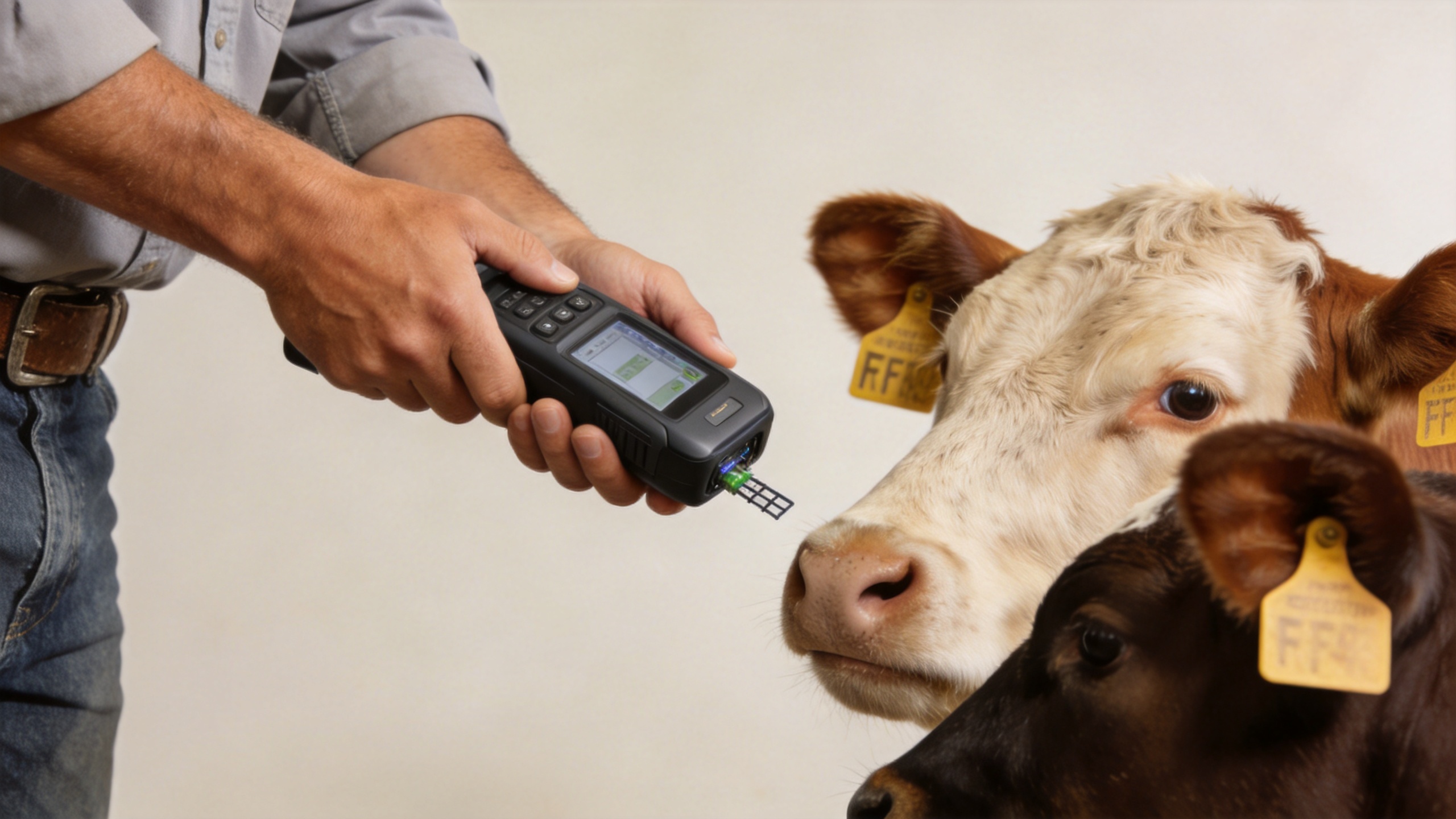
Where fixed RFID readers earn their place
Fixed readers are installed at a defined read zone. In livestock systems, that may be a chute, alley, gate, scale, or other managed passage point. Their value is consistency: when the animal passes through the designed zone, the system can capture a read without asking a staff member to operate a reader for every animal.
That makes fixed hardware most compelling when the same movement happens often enough to justify setup and validation. For example, a feedlot or dairy may have repeatable processing points where reliable event capture improves record completeness. But a fixed system is not simply a reader mounted on a wall. Read-zone layout, antenna placement, animal speed, tag orientation, shielding, cabling, power, network access, and software event rules all influence the result.
| Decision factor | Handheld RFID reader | Fixed RFID reader |
|---|---|---|
| Typical fit | Mobile checks, audits, treatment, temporary sites | Repeatable movement through a known location |
| Labor model | Operator-led scan | Automated capture after commissioning |
| Upfront setup | Usually simpler | Requires site design, installation, and testing |
| Coverage | Follows the operator | Limited to the engineered read zone |
| Best rollout use | Validate tags and workflow first | Scale a proven high-frequency workflow |
Start with tag and protocol compatibility
The most important selection rule is simple: do not choose a reader before confirming the tag technology and the records system it must support. Livestock ear tags may use different frequencies and protocols. Where an operation uses ISO 11784/11785 FDX-B or HDX identification, buyers should verify that the reader supports the required format. The same review should cover local program requirements, data format, farm-management software, and any planned barcode or QR workflow.
For a handheld RFID reader, ask for a demonstration using your actual tags in a realistic environment. For a fixed system, run the same test across the full movement path—not only a stationary bench test. Record missed reads, duplicate reads, tag orientation effects, and the steps an operator takes when data does not match. That evidence is more useful than a generic read-range claim.
A practical selection checklist
- Map the animal journey. Identify every point where an ID is needed: tagging, treatment, weighing, sorting, loading, or compliance checks.
- Measure event frequency. A once-a-month audit favors a mobile tool; repeated daily or weekly movement can support fixed automation.
- Confirm tag-reader compatibility. Verify tag type, protocol, frequency, and required software integration before ordering.
- Define the exception process. Decide how staff handle a missed read, damaged tag, duplicate record, or animal that bypasses the normal lane.
- Test in field conditions. Include animal motion, dust, moisture, staff routines, and the real device-to-software handoff.
- Plan a phased rollout. Many operations begin with a handheld unit, document the workflow, then add fixed points where repeatable throughput justifies them.
Handheld RFID reader evaluation questions
Use the following questions during a trial. Can the handheld RFID reader capture the tags already used in the herd? Can the handheld RFID reader keep working for a full handling session? Does the handheld RFID reader give staff a clear confirmation when a record is found? These basic tests help separate a suitable handheld RFID reader from a device that only looks appropriate on a specification sheet.
- Test the handheld RFID reader with a restrained animal and with animals moving through the normal working area.
- Check whether the handheld RFID reader can export or synchronize the fields your records system needs.
- Ask how the handheld RFID reader handles an unreadable or replacement tag.
- Confirm battery charging, cleaning, protective cases, and repair support for the handheld RFID reader.
- Make sure each handheld RFID reader is assigned to a clear operator workflow, not left as an unplanned backup tool.
For a small operation, one handheld RFID reader may cover every essential task. For a larger site, several units may let staff audit pens while a fixed system captures routine movements. In both cases, train the team on the same record-creation and exception steps. A handheld RFID reader is most valuable when the scan leads to a consistent action: verify identity, update the record, flag an exception, or direct the animal to the next process.
Before expanding a deployment, review scan logs from the handheld RFID reader. Look for recurring missed reads by location, tag type, or handling stage. If a location produces a predictable volume of scans, that evidence may support a fixed reader. If the work remains seasonal or dispersed, retaining the handheld RFID reader as the primary tool can be the more efficient choice. This data-led approach avoids installing fixed hardware simply because automation sounds attractive.
Why a hybrid approach is often the strongest option
The choice does not have to be absolute. A fixed reader can collect routine events at the main handling point, while a handheld RFID reader covers field checks, exceptions, and temporary work areas. This combination keeps automation focused where it has the clearest return while preserving a reliable manual fallback.
For buyers building or updating a livestock identification system, it is also useful to evaluate reader hardware alongside tag supply. BLUEWORTH offers RFID-compatible and visual identification options, and its BLUEWORTH Animal UHF RFID Ear Tag Scanner C5 Ear Tag Handle Reader QR code scanner can be reviewed as part of a broader identification workflow. Confirm the exact tag and reader compatibility for your operation before purchase.
Make the decision around the workflow, not the device label
Choose a handheld RFID reader when flexibility, mobility, and pilot-stage learning matter most. Choose fixed readers when animals repeatedly pass through a controlled point and consistent automatic capture can reduce manual work. In either case, treat installation and procurement as one system project: validate the tag, the protocol, the read environment, the data path, and the operator response to exceptions. That approach gives a livestock operation a clearer path from individual scans to dependable identification records.