EN
EN

Ceramic Cat Water Fountain vs. Plastic: What Should Buyers Compare?
For distributors, pet retailers, and sourcing teams, choosing a water fountain for cats ceramic is not simply a style decision. The body material affects receiving checks, cleaning routines, breakage exposure, replacement planning, and the way customers judge product quality after purchase. A plastic model can be practical for a price-led range, while a ceramic option can support a more premium position. The useful comparison starts with the whole system—not a claim that one material is automatically superior.
This guide treats the water fountain for cats ceramic category as a procurement decision. It compares cleaning access, capacity, user experience, product durability, packaging, and supplier documentation so buyers can build a line that fits their market.
Start with the use case, not the material label
A water fountain for cats ceramic may suit a premium retail collection, gift-oriented assortment, or customer segment that values a substantial tabletop product. Plastic fountains may fit entry-level programs, lighter shipping targets, or campaigns where several colors and lower landed cost matter. Neither choice removes the need to evaluate the pump, filter path, cable protection, reservoir design, and service parts.
Ask the supplier to define the intended daily use: one-cat household, multi-cat household, heated-water use, or a retailer’s private-label program. Then sample the exact configuration. A ceramic pet drinking fountain should be assessed as an assembled appliance, including its tray, electrical components, filters, and instructions, rather than as a ceramic vessel alone.
Compare cleanability by access points and surface condition
Cleanability is often the first reason buyers consider a water fountain for cats ceramic. Glazed surfaces can be easy to wipe when the finish is smooth and intact, but buyers should verify the glaze, edges, openings, joints, and underside in a physical sample. Inspect for chips, pinholes, sharp edges, rough patches, and areas where water can sit out of view. Those details matter more than a broad “easy to clean” statement.
Plastic models should receive the same inspection. Review molding seams, corners around the pump chamber, lid fit, transparent level windows, and the parts that must be removed for a regular wash. For both materials, ask the supplier for a disassembly sequence and confirm that a customer can reach the reservoir, impeller area, filter housing, and drinking surface without tools that are not included.
- Can each wet-contact part be removed and reassembled correctly?
- Are spare filters and pump-cleaning accessories available for reorder?
- Does the instruction sheet state a realistic cleaning interval and replacement schedule?
- Will normal cleaning expose a fragile edge, loose fitting, or difficult-to-dry cavity?
Evaluate durability in the real supply chain
A water fountain for cats ceramic usually requires closer attention to impact protection. Ceramic can feel substantial and present well on a shelf, yet its shipping performance depends on wall thickness, tray geometry, foam or pulp protection, carton design, drop-test discipline, and how replacement parts are packed. Request sample cartons and inspect both the product and the internal protection after transport.
Plastic generally reduces breakage risk in parcel handling, but it is not automatically durable. Check hinge points, latches, feet, cord exits, thin walls, and the fit between the reservoir and top cover. A sourcing decision should separate cosmetic scuff resistance from functional durability. If a component cracks, can the supplier provide a replacement part, or must the retailer replace the complete unit?
For an import program, record the packaging dimensions, gross weight, units per carton, breakage acceptance criteria, and claims process before issuing a purchase order. That turns the ceramic-versus-plastic debate into a measurable landed-cost comparison.
Use capacity and water management as operational criteria
Capacity should reflect household usage, refill expectations, and the fountain’s water path. Do not assume a larger reservoir automatically means easier ownership; buyers should also check visibility of the water level, cleaning access at full capacity, stability when moved, and whether the pump can operate safely as the water level falls.
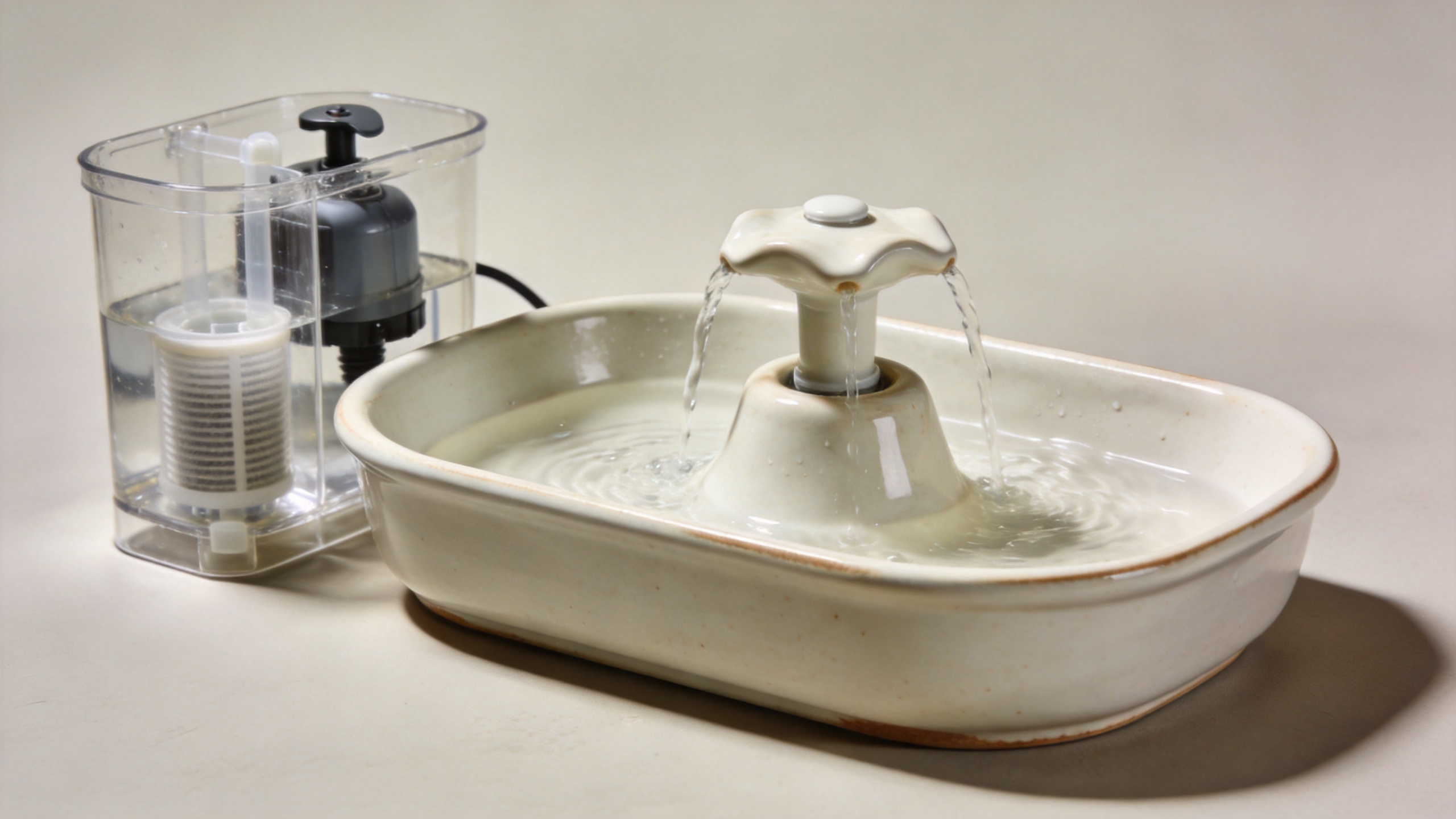
One verified product option is the MDC288 Smart Pet Water Fountain with Ceramic Tray. Its supplier listing identifies a 4.5 L capacity and describes clean/dirty water separation plus constant-temperature heating. Buyers should treat those as specification points to validate in a sample and production documentation, including actual capacity, heating controls, electrical-market suitability, cleaning method, and replacement-filter availability.
For a water fountain for cats ceramic, also confirm that the ceramic portion does not make routine refilling awkward for the intended user. For plastic, check whether a lightweight empty body becomes unstable during use. A good buying brief includes a filled-unit handling test, a noise observation, and a refill test, not only a capacity number.
Compare user experience without making unsupported health claims
Customers may perceive a water fountain for cats ceramic as more premium because of its weight and finish. Plastic can support more color choices and a lighter form factor. These are merchandising considerations, not proof of superior pet-health outcomes. Avoid claims that a material prevents a condition or guarantees cleaner water unless the supplier can provide market-appropriate, documented evidence.
Instead, build a practical experience checklist: Does the fountain sit steadily? Is the drinking area comfortable to reach? Can users hear the pump at a normal room distance? Is the refill point intuitive? Are the filters, pump, cable, and care instructions easy to identify? In a ceramic pet drinking fountain, verify that the finished surface remains consistent across samples; in plastic, verify that color, fit, and translucency match the approved sample.
Build the cost comparison around total ownership
The unit price of a water fountain for cats ceramic is only one input. Compare product price with packaging cost, freight weight, breakage allowance, warranty exposure, spare-part availability, and return handling. A plastic fountain can be attractive when freight efficiency and lower replacement risk are priorities. A ceramic model can be attractive when retail positioning and perceived finish support a different price tier.
| Buying factor | Ceramic focus | Plastic focus |
|---|---|---|
| Cleaning review | Glaze integrity, edges, removable tray | Seams, corners, removable wet-contact parts |
| Shipping review | Impact protection and breakage criteria | Scuffing, deformation, component fit |
| Merchandising | Premium finish and stable presentation | Color range, lightweight format, price positioning |
| Service plan | Replacement ceramic part feasibility | Replacement cover, reservoir, or pump feasibility |
Supplier questions to ask before approval
A buyer comparing a water fountain for cats ceramic with plastic alternatives should request answers in writing. Confirm the bill of materials, product dimensions, net and gross weight, packaging specification, wet-contact component list, filter and pump part numbers, cleaning instructions, inspection criteria, and applicable compliance documentation for the destination market. If heating or powered components are included, obtain the exact electrical specification and the documents appropriate to the sales region.
- What changes are permitted after sample approval, and how are they communicated?
- Which parts can be reordered separately, with lead times and minimum quantities?
- What are the incoming inspection standards for surface finish, fit, leakage, pump operation, and packaging?
- What evidence supports any material, capacity, heating, or separation claim shown in product content?
- What is the agreed remedy for transit damage or a production defect?
The purchasing decision: match the material to the program
Choose a water fountain for cats ceramic when your sample review confirms a consistent glaze, accessible cleaning, resilient packaging, and a retail position that supports the added handling requirements. Choose plastic when its design provides easier logistics, an appropriate price point, and equally clear maintenance access. In either case, approve the complete system: body, pump, filter, cables, documentation, packaging, and replacement plan.
The strongest procurement outcome is not “ceramic wins” or “plastic wins.” It is a fountain program with defined quality checks, honest product claims, repeatable cleaning instructions, and a supplier that can support the configuration after the first shipment.