EN
EN

Cattle Prodders vs. Manual Livestock Handling Tools: When to Evaluate Each
Choosing between cow prodders and manual livestock handling tools is not a simple question of speed. For a cattle operation, the better question is: what is preventing the animal from moving, and what is the lowest-stress, safest way to resolve it? Cow prodders can be evaluated as a limited handling aid in tightly defined situations, but they should not substitute for sound facilities, trained people, or calm stockmanship.
For a buyer reviewing a handling program, this distinction shows up quickly on the ground. A tool that appears to solve a short-term bottleneck can create more handling pressure if the underlying cause is a blind corner, slippery footing, crowding, noise, or an operator standing in the wrong place. Before comparing cow prodders, review the flow of cattle through the actual working area and the local rules that govern handling equipment.
Start with the handling problem, not the tool
Low-stress cattle handling guidance commonly starts with animal behavior: cattle respond to movement, contrast, light, pressure, and the handler’s position. A cow that stops at a race entrance may be reacting to glare, a hanging object, an abrupt transition, or loss of a clear route forward. In those cases, manual livestock handling tools and a small facility adjustment can be more appropriate than cow prodders.
Manual tools include paddles, flags, sorting sticks, rattle-style aids, and visual barriers used to guide attention without routine electrical stimulus. Their value is not that they force an animal to move. Their value is that a trained handler can use them alongside flight-zone awareness, a clear escape path, and measured pressure-and-release timing. If cattle regularly hesitate at the same point, treat that repeatable pattern as a system issue to investigate.
When manual tools deserve priority
Evaluate manual livestock handling tools first when cattle are generally healthy, the group has room to move, and the task is routine sorting, loading, pen movement, or movement through a familiar facility. They are especially useful when the objective is to keep handlers focused on position and animal response rather than escalating pressure. They also make it easier to identify whether the real bottleneck is poor lighting, a sharp turn, a loud gate, crowding, or inconsistent handling.
- Routine movement: use visual guidance and calm positioning before considering cow prodders.
- New or nervous cattle: reduce noise, improve line of sight, and allow time for animals to orient.
- Repeated refusal at one point: inspect footing, shadows, gates, transitions, and alley width.
- Mixed-experience crews: prioritize training and a shared handling plan over adding more forceful tools.
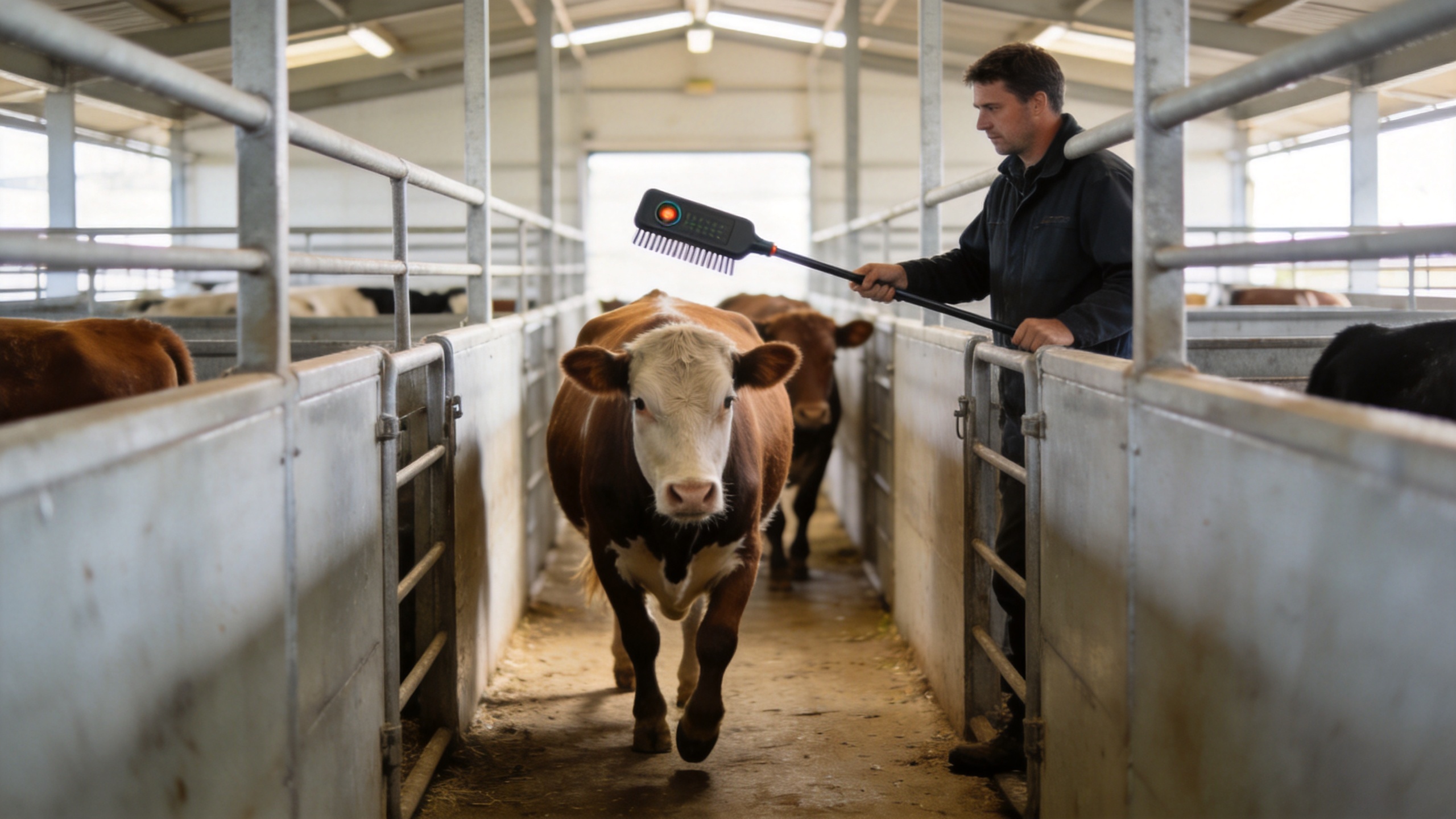
This approach is not slower by definition. Appropriate confinement and handling equipment can reduce labor and risk when it is matched to the job. That usually points back to the choke point itself before it points to another tool.
When to evaluate cow prodders
Cow prodders may be evaluated for a narrow, exceptional need: an animal that is stubbornly refusing to move after the handler has checked the route, reduced avoidable stressors, and used lower-impact guidance. Even then, use should be limited, controlled, and consistent with local welfare requirements and the facility’s handling policy. Do not treat cow prodders as routine equipment for making a line move faster.
For buyers assessing an electric cow prodder, practical questions include battery format, shaft length for the facility geometry, grip and durability, storage, inspection, and who is authorized to use it. These are product-evaluation questions, not a reason to expand use. A rechargeable option may simplify readiness checks, but it does not change the need for a written, welfare-centered protocol.
| Evaluation factor | Manual tools first | Cow prodders only after review |
|---|---|---|
| Likely cause | Normal hesitation, attention, or handler positioning | Exceptional refusal after lower-impact options and facility checks |
| Primary control | Visual cues, flight-zone work, route clarity | Restricted authorization and minimal necessary use |
| Review point | Before each routine handling task | After confirming the problem is not a design or process failure |
| Key risk to manage | Inconsistent technique | Overuse, escalation, welfare concerns, and noncompliance |
Build a decision framework for procurement and operations
A consideration-stage purchase decision should compare the whole handling system, not just unit price. Ask what proportion of handling delays occur at the same location, which animals are affected, whether a trained handler can resolve the issue with manual tools, and what records the operation keeps on slips, falls, balking, and tool use. If an electric aid is being requested repeatedly, that repeat rate is a prompt to inspect the process.
- Map the route and identify locations where cattle stop or turn back.
- Check lighting, flooring, distractions, crowding, and gate operation.
- Observe whether manual tools, handler position, and a clearer route resolve the issue.
- Confirm the applicable local rules and your internal animal-handling policy.
- Only then evaluate cow prodders for a tightly limited, documented purpose.
Training belongs in the evaluation. A tool cannot compensate for a handler who does not understand pressure zones, safe positioning, or when to pause. Likewise, an experienced team should avoid assuming that familiarity with cow prodders makes them the preferred response. A sound program starts with calm movement, then reviews the setup whenever that approach repeatedly breaks down.
Choosing an electric cow prodder without overclaiming
If a documented need remains, compare livestock-specific products against the site’s actual conditions. For example, a product such as BLUEWORTH Swine/Cattle Electric Prodder Pig Prod 3.7V/7.4V Li-Battery 2600mAh 5 Sizes of Shaft Livestock Driving can be reviewed as one available product listing. Buyers should independently verify the supplied configuration, suitability, local requirements, and safe-use instructions before purchase or deployment.
Do not infer welfare performance from a catalogue description alone. The relevant operating standard is whether the team can prevent avoidable distress, maintain safe movement, and use any electric cow prodder only within a controlled policy. Store cow prodders securely, inspect them before use, and remove defective equipment from service. These controls help keep a limited tool from becoming an automatic response.
Conclusion: choose the lowest-pressure effective option
A suitable time to evaluate cow prodders is after you have assessed animal behavior, facilities, staff technique, manual livestock handling tools, and local requirements. For most planned cattle movement, manual guidance and better flow design should be the starting point. Where cow prodders are considered at all, define the exceptional use case, train authorized staff, monitor outcomes, and revisit the underlying cause whenever use becomes frequent. That is a more defensible approach for animal welfare, worker safety, and long-term handling efficiency.